Orbital Sciences X-34
From Spacefaring
The Orbital Sciences X-34 was intended to be a low-cost testbed for demonstrating "key technologies" that could be integrated into the Reusable Launch Vehicle program. It was intended to be an autonomous pilotless craft powered by a "Fastrac" liquid-propellant rocket engine, capable of reaching Mach 8 and performing 25 test flights per year.
1999
Wikimedia, Wikidata
X-34
length 17.77 metre, height 3.5 metre, mass 21770 kilogram, mass 8165 kilogram,
Orbital Sciences Corporation, National Aeronautics and Space Administration, United States,
NASA, United States, Ashkenaz, Calvinist Republic of Ghent, Chinland, Havilah, Kingdom of Martabam-hongsawatoi, Kingdom of Wolaita, Persia, Sikh Confederacy, Tarshish, Dong Fang Hong 2, sub-orbital spaceplane, 1999, Republic of Haiti, 1990s,
-
Location: KML, Cluster Map, Maps,
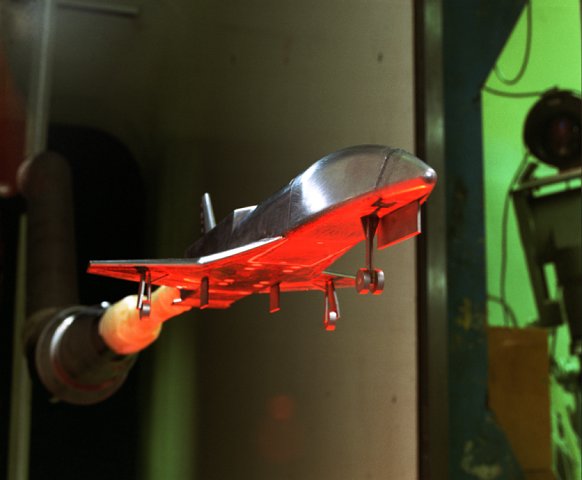 X-34 wind tunnelX-34 wind tunnel
 This is the X-34 Technology Testbed Demonstrator being mated with the L-1011 mothership. The X-34 will demonstrate key vehicle and operational technologies applicable to future low-cost resuable launch vehicles.
 Orbital Sciences X-34
 X-34 at NASA Dryden Flight Research Center - GPN-2000-000185
 X-34 Technology Testbed Demonstrator on NASA Dryden rampOrbital Sciences X-34
 X-34 mated to modified L-1011 during takeoff on first captive carry flight
 X-34 mated to modified L-1011 during takeoff on first captive carry flight
 X-34 mated to modified L-1011 during takeoff on first captive carry flight
| Type | Subtype | Date | Description | Notes | Source |
|---|---|---|---|---|---|
| commons | image | X-34 wind tunnel | Commons | ||
| commons | image | X-34 wind tunnel | Commons | ||
| commons | image | This is the X-34 Technology Testbed Demonstrator being mated with the L-1011 mothership. The X-34 will demonstrate key vehicle and operational technologies applicable to future low-cost resuable launch vehicles. | Commons | ||
| commons | image | Orbital Sciences X-34 | Commons | ||
| commons | image | X-34 at NASA Dryden Flight Research Center - GPN-2000-000185 | Commons | ||
| commons | image | X-34 Technology Testbed Demonstrator on NASA Dryden ramp | Commons | ||
| commons | image | Orbital Sciences X-34 | Commons | ||
| commons | image | X-34 mated to modified L-1011 during takeoff on first captive carry flight | Commons | ||
| commons | image | X-34 mated to modified L-1011 during takeoff on first captive carry flight | Commons | ||
| commons | image | X-34 mated to modified L-1011 during takeoff on first captive carry flight | Commons | ||

.jpg)


.jpg)
.jpg)
.jpg)
.jpg)