Q119807: Difference between revisions
From Spacefaring
Q119807
Bot: Automated import of articles *** existing text overwritten *** |
Bot: Automated import of articles *** existing text overwritten *** |
||
| Line 1: | Line 1: | ||
{{Page|Gemini 7| | {{Page|Gemini 7|Objects|1965 crewed spaceflight in NASA's Gemini program|Gemini VII}} | ||
Revision as of 16:17, 17 February 2025
Gemini 7 was a 1965 crewed spaceflight in NASA's Gemini program. It was the fourth crewed Gemini flight, the twelfth crewed American spaceflight, and the twentieth crewed spaceflight including Soviet flights and X-15 flights above the Kármán line. The crew of Frank Borman and Jim Lovell spent nearly 14 days in space, making a total of 206 orbits. Their spacecraft was the passive target for the first crewed space rendezvous performed by the crew of Gemini 6A.
1965
Wikimedia, Wikidata
Gemini VII
low Earth orbit, Titan II GLV, Jim Lovell, Frank Borman, .jpg)
-
Location: KML, Cluster Map, Maps,
1965-12-04T00:00:00Z
1965-12-04T00:00:00Z
1965 Gemini 7
1965-12-18T00:00:00Z
1965-12-18T00:00:00Z
splashdown
1965-12-04T00:00:00Z
1965-12-04T00:00:00Z
rocket launch
{"selectable":false,"showCurrentTime":false,"width":"100%","zoomMin":100000000000}
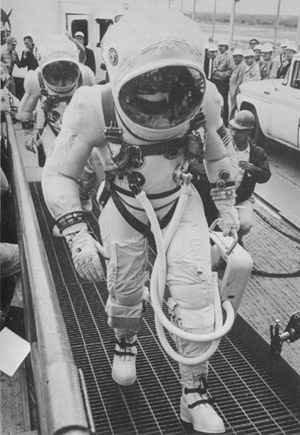 G5C spacesuit
 Gemini 7 over the Pacific Ocean during rendezvous with Gemini 6
 Gemini 7 Crew (Lovell und Borman)
 The new light-weight spacesuit planned for possible use during the Gemini-7 mission is modeled by Fred R. Spross, Gemini Support Office
 Gemini 7 Flown Fliteline Gold-Plated Sterling Silver Medallion
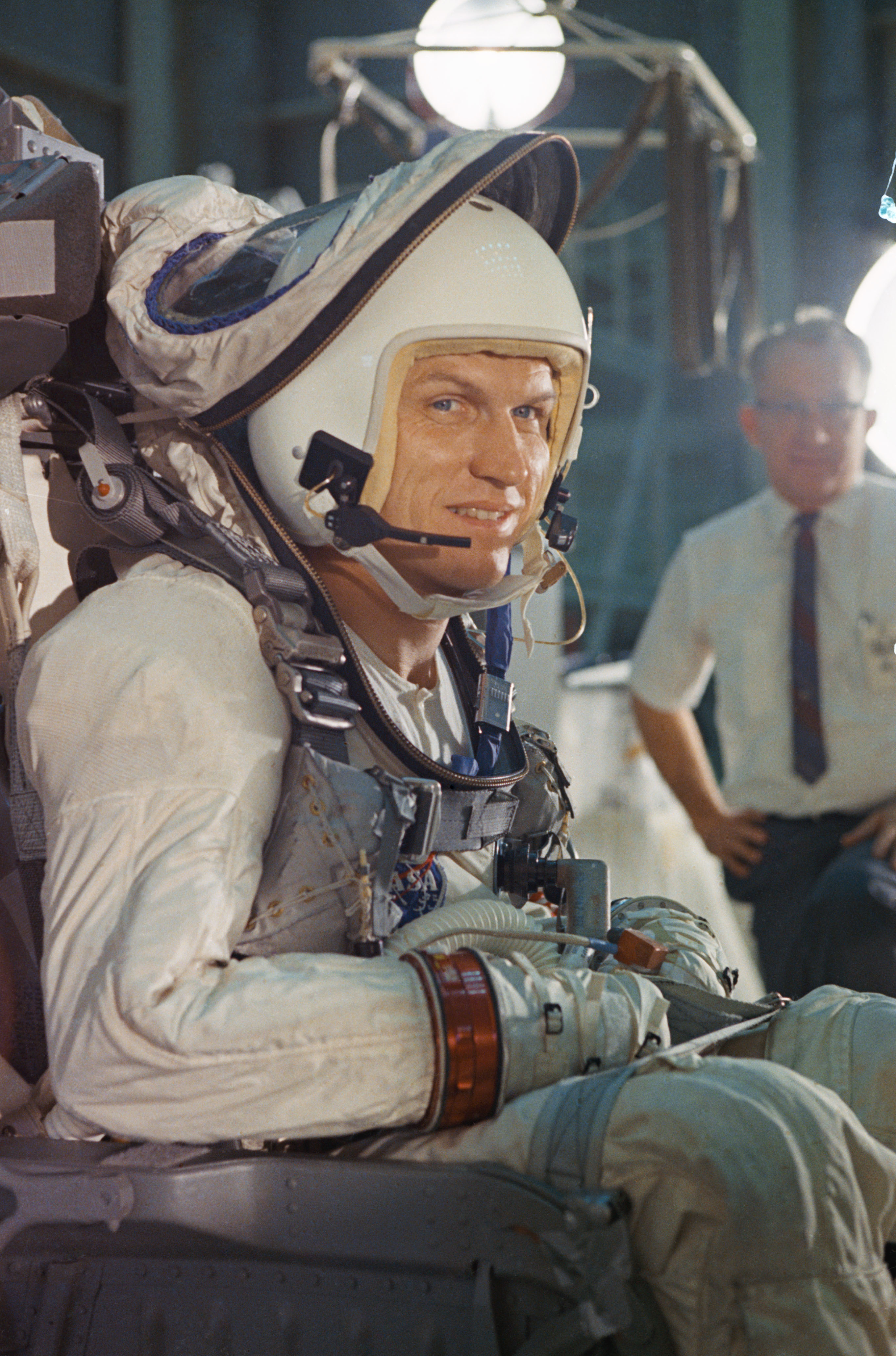 Frank Borman during training for Gemini 7 mission
 Astronaut Frank Borman, command pilot for the Gemini-7 spaceflight, looks over the Gemini-7
 S65-57481 (25 Oct. 1965) --- Astronaut James A. Lovell Jr., pilot of the Gemini-7 spaceflight, undergoes weight and balance tests in the Pyrotechnic Installation Building, Merritt Island, Kennedy Space Center.
 S65-57987 (1 Nov. 1965) --- The prime and backup crews of Gemini-7 spaceflight, scheduled for early December 1965, met with members of various news media at the MSC News Center. Left to right, are astronauts James A. Lovell Jr.
 S65-61835 (15 Nov. 1965) --- Technicians assist the prime crew for the Gemini-7 spaceflight in systems checks inside their spacecraft in the White Room atop Pad 19.
- Analysis of brain wave records from Gemini flight GT-7 by computations to be used in a thirty day primate flight. - scientific article published in January 1967


_(s65-57481).jpg)
.jpg)
.jpg)