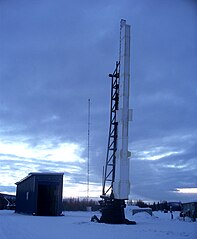
NASA Talos-Terrier-Oriole-Nihka sounding rocket - ready for launch, Poker Flat, Alaska.jpg
From Spacefaring

Original file (3,000 × 3,647 pixels, file size: 2 MB, MIME type: image/jpeg)
| Description |
A NASA Talos--Terrier-Oriole-Nihka sounding rocket stands ready for launch at the Poker Flat Research Range in Alaska, waiting for the right launch conditions. The rocket and VISIONS payload are enclosed in foam to help maintain temperatures. This will be the first flight of this rocket configuration. The VISIONS (VISualizing Ion Outflow via Neutral atom imaging during a Substormsounding) sounding rocket mission will study aurora. Late on the night of Feb. 5, 2013, the clouds cleared, but there were no strong auroras, which are a prerequisite for launch. The principal investigator for VISIONS, Doug Rowland, reported in the early morning of Feb. 6, 2013: "Tonight was incredibly quiet. We are scrubbing now because we are very close to the end of tonight's window, and there is a plane requesting permission to fly through our downrange area. The solar wind was very quiet, and only one very small substorm occurred, too weak for our launch criteria. We are back on for tomorrow night, from 10 p.m. to 4 a.m. There is some space weather activity, what's called a 'corotating interaction region,' supposed to arrive tomorrow, and a coronal mass ejection the day or two after that, so we are hopeful for some increased auroral activity." --- To read more about the VISIONS mission go to: <a href="http://www.nasa.gov/mission_pages/sunearth/news/visions-aurora.html" rel="nofollow">www.nasa.gov/mission_pages/sunearth/news/visions-aurora.html</a> VISIONS: Seeing the Aurora in a New Light A team of NASA scientists arrived in Poker Flats, Alaska at the end of January, 2013. The team is patiently waiting for the exotic red and green glow of an aurora to illuminate the sky. Instead of simply admiring the view, this group from NASA's Goddard Space Flight Center of Greenbelt, Md., and The Aerospace Corporation of El Segundo, Calif. will launch a sounding rocket up through the Northern Lights. The rocket could launch as early as the night of Feb. 2, 2013, but the team has a two-week window in order to find the perfect launch conditions. Armed with a series of instruments developed specifically for this mission, the VISIONS (VISualizing Ion Outflow via Neutral atom imaging during a Substorm) rocket will soar high through the arctic sky to study the auroral wind, which is a strong but intermittent stream of oxygen atoms from Earth’s atmosphere into outer space. The rocket will survive only fifteen minutes before splashing down in the Arctic Ocean, but the information it obtains will provide answers to some long-standing questions. VISIONS is studying how oxygen atoms leave Earth’s atmosphere under the influence of the aurora. Most of the atmosphere is bound by Earth’s gravity, but a small portion of it gets heated enough by the aurora that it can break free, flowing outwards until it reaches near-Earth space. The atoms that form this wind initially travel at about 300 miles per hour -- only one percent of the speed needed to overcome gravity and leave Earth's atmosphere. The principal investigator for VISIONS, Goddard's Doug Rowland is providing images while the team prepares for launch. VISIONS is a partnership between NASA Goddard and the Aerospace Corporation of El Segundo, Calif. The sounding rocket motors and payload support systems are provided by NASA Wallops Flight Facility, including NSROC, the NASA Sounding Rocket Operations Contract. The Poker Flat Research Range is operated by the University of Alaska under contract to NASA. NASA Goddard Space Flight Center enables NASA’s mission through four scientific endeavors: Earth Science, Heliophysics, Solar System Exploration, and Astrophysics. Goddard plays a leading role in NASA’s accomplishments by contributing compelling scientific knowledge to advance the Agency’s mission. |
||
| Date | |||
| Source | Flickr: VISIONS: Seeing the Aurora in a New Light | ||
| Author | NASA Goddard Space Flight Center | ||
| Permission (Reusing this file) |
  This file is licensed under the Creative Commons Attribution 2.0 Generic licence.
|




File history
Click on a date/time to view the file as it appeared at that time.
| Date/Time | Thumbnail | Dimensions | User | Comment | |
|---|---|---|---|---|---|
| current | 19:53, 28 April 2013 | | 3,000 × 3,647 (2 MB) | wikimediacommons>Flickr upload bot | Uploaded from http://flickr.com/photo/24662369@N07/8450673693 using Flickr upload bot |
File usage
There are no pages that use this file.
