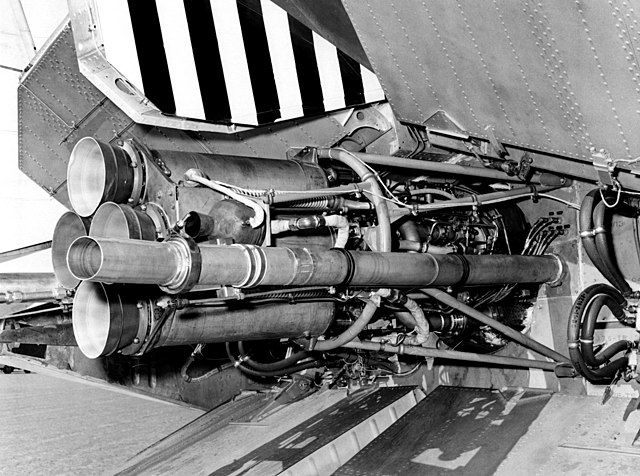
XLR-11 Engine Close-up in X-24A.jpg
From Spacefaring
Original file (3,000 × 2,233 pixels, file size: 2.87 MB, MIME type: image/jpeg)
This file is from Wikimedia Commons and may be used by other projects. The description on its file description page there is shown below.
Summary
| DescriptionXLR-11 Engine Close-up in X-24A.jpg |
English: This photo shows a close-up view of the XLR-11 rocket engine mounted in the X-24A lifting body research vehicle. The X-24A would be air-launched from a B-52 mothership, and then its pilot would light the XLR-11 rocket engine for the powered portion of the research flight. The X-24A would then glide back to a landing on a lakebed near the NASA Flight Research Center, Edwards, California. |
| Date | |
| Source | http://www.dfrc.nasa.gov/Gallery/Photo/X-24/HTML/E-23356.html |
| Author | NASA |
This image or video was catalogued by Armstrong Flight Research Center of the United States National Aeronautics and Space Administration (NASA) under Photo ID: E-23356 and Alternate ID: NIX-E-23356. This tag does not indicate the copyright status of the attached work. A normal copyright tag is still required. See Commons:Licensing. Other languages:
Afrikaans ∙ العربية ∙ беларуская (тарашкевіца) ∙ български ∙ Bahaso Jambi ∙ català ∙ čeština ∙ dansk ∙ Deutsch ∙ English ∙ español ∙ فارسی ∙ français ∙ galego ∙ magyar ∙ հայերեն ∙ Bahasa Indonesia ∙ italiano ∙ 日本語 ∙ македонски ∙ മലയാളം ∙ Nederlands ∙ polski ∙ português ∙ русский ∙ sicilianu ∙ slovenščina ∙ Türkçe ∙ українська ∙ 简体中文 ∙ 繁體中文 ∙ +/− |
Licensing
| Public domainPublic domainfalsefalse |
| This file is in the public domain in the United States because it was solely created by NASA. NASA copyright policy states that "NASA material is not protected by copyright unless noted". (See Template:PD-USGov, NASA copyright policy page or JPL Image Use Policy.) | ||
Warnings:
|
Captions
Items portrayed in this file
depicts
1971
image/jpeg
3,013,391 byte
2,233 pixel
3,000 pixel
9dd14cc1e5dbb4beacc5a19ae8356daf6ba1b929
File history
Click on a date/time to view the file as it appeared at that time.
| Date/Time | Thumbnail | Dimensions | User | Comment | |
|---|---|---|---|---|---|
| current | 01:54, 16 May 2021 | 3,000 × 2,233 (2.87 MB) | wikimediacommons>Huntster | Cropped 15 % vertically using CropTool with lossless mode. |
File usage
There are no pages that use this file.
Metadata
This file contains additional information, probably added from the digital camera or scanner used to create or digitise it.
If the file has been modified from its original state, some details may not fully reflect the modified file.
| JPEG file comment | NASA Dryden Flight Research Center Photo Collection
http://www.dfrc.nasa.gov/gallery/photo/index.html NASA Photo: E-23356 Date: 1971 XLR-11 Engine Close-up in X-24A This photo shows a close-up view of the XLR-11 rocket engine mounted in the X-24A lifting body research vehicle. The X-24A would be air-launched from a B-52 mothership, and then its pilot would light the XLR-11 rocket engine for the powered portion of the research flight. The X-24A would then glide back to a landing on a lakebed near the NASA Flight Research Center, Edwards, California. The X-24 was one of a group of lifting bodies flown by the NASA Flight Research Center (now Dryden Flight Research Center), Edwards, California, in a joint program with the U.S. Air Force at Edwards Air Force Base from 1963 to 1975. The lifting bodies were used to demonstrate the ability of pilots to maneuver and safely land wingless vehicles designed to fly back to Earth from space and be landed like an airplane at a predetermined site. <p> Lifting bodies’ aerodynamic lift, essential to flight in the atmosphere, was obtained from their shape. The addition of fins and control surfaces allowed the pilots to stabilize and control the vehicles and regulate their flight paths. <p> Built by Martin Aircraft Company, Maryland, for the U.S. Air Force, the X-24A was a bulbous vehicle shaped like a teardrop with three vertical fins at the rear for directional control. It weighed 6,270 pounds, was 24.5 feet long and 11.5 feet wide (measuring just the fuselage, not the distance between the tips of the outboard fins). Its first unpowered glide flight was on April 17, 1969, with Air Force Maj. Jerauld Gentry at the controls. Gentry also piloted its first powered flight on March 19, 1970. <p> The X-24A was flown 28 times in the program that, like the HL-10, validated the concept that a Space Shuttle vehicle could be landed unpowered. The fastest speed achieved by the X-24A was 1,036 miles per hour (mph--Mach 1.6). Its maximum altitude was 71,400 feet. It was powered by an XLR-11 rocket engine with a maximum theoretical vacuum thrust of 8,480 pounds. <p> The X-24A was later modified into the X-24B. The bulbous shape of the X-24A was converted into a "flying flatiron" shape with a rounded top, flat bottom, and double delta platform that ended in a pointed nose. The X-24B demonstrated that accurate unpowered reentry vehicle landings were operationally feasible. Top speed achieved by the X-24B was 1,164 mph and the highest altitude it reached was 74,130 feet. The vehicle is on display at the Air Force Museum, Wright-Patterson Air Force Base, Ohio. The pilot on the last powered flight of the X-24B was Bill Dana, who also flew the last X-15 flight about seven years earlier. <p> The X-24A shape was later borrowed for the X-38 Crew Return Vehicle (CRV) technology demonstrator for the International Space Station. |
|---|