NOTS-EV-2 Caleb
From Spacefaring
Q6954966
The NOTS-EV-2 Caleb, also known as NOTS-500, Hi-Hoe and SIP was an expendable launch system, which was later used as a sounding rocket and prototype anti-satellite weapon. It was developed by the United States Navy's Naval Ordnance Test Station (NOTS) as a follow-up to the NOTS-EV-1 Pilot, which had been abandoned following ten launches officially classified as failed missions. Two were launched in July and October 1960, before the cancellation of the project. Following cancellation, two leftover Calebs were used in the Satellite Interceptor Program (SIP), while three more were used as sounding rockets, under the designation Hi-Hoe. These derivatives flew until July 1962, when the Hi-Hoe made its final flight.
Wikimedia, Wikidata
Hi-Hoe; NOTS-500; SIP
United States Navy, United States,
United States, Dong Fang Hong 2, expendable launch vehicle,
-
Location: KML, Cluster Map, Maps,
 F4D with Caleb
 Caleb rocket
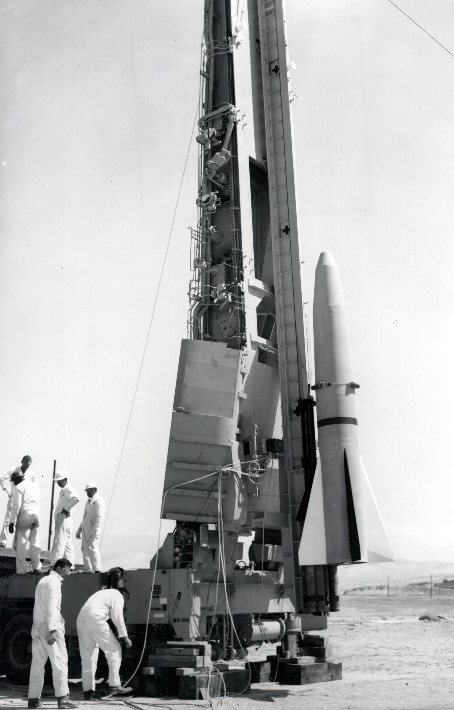 SIP rocket
 Hi-Hoe sounding rocket on F4H Phantom
| Type | Subtype | Date | Description | Notes | Source |
|---|---|---|---|---|---|
| commons | image | F4D with Caleb | Commons | ||
| commons | image | Caleb rocket | Commons | ||
| commons | image | SIP rocket | Commons | ||
| commons | image | Hi-Hoe sounding rocket on F4H Phantom | Commons | ||


