Q62833385: Difference between revisions
From Spacefaring
Q62833385
Bot: Automated import of articles *** existing text overwritten *** |
Bot: Automated import of articles *** existing text overwritten *** |
||
| Line 1: | Line 1: | ||
{{Page|Starship|Classes|SpaceX super heavy-lift reusable launch vehicle|SpaceX Starship | {{Page|Starship|Classes|SpaceX super heavy-lift reusable launch vehicle|SpaceX Starship; Starship-Super Heavy}} | ||
Latest revision as of 12:52, 2 September 2025
Starship is a two-stage, fully reusable, super heavy-lift launch vehicle under development by American aerospace company SpaceX. Currently built and launched from Starbase in Texas, it is intended as the successor to the company's Falcon 9 and Falcon Heavy rockets, and is part of SpaceX's broader reusable launch system development program. If completed as designed, Starship would be the first fully reusable orbital rocket and have the highest payload capacity of any launch vehicle to date. As of October 13, 2025, Starship has launched 11 times, with 6 successful flights and 5 failures.
2005 Website,
Wikimedia, Wikidata
SpaceX Starship; Starship-Super Heavy
mass 5000 tonne, height 123 metre, diameter 9 metre,
SpaceX, United States,
SpaceX, United States, Dong Fang Hong 2, Ekran, reusable launch vehicle, super heavy-lift launch vehicle, 2005, [[Starship|]],
-
Location: KML, Cluster Map, Maps,
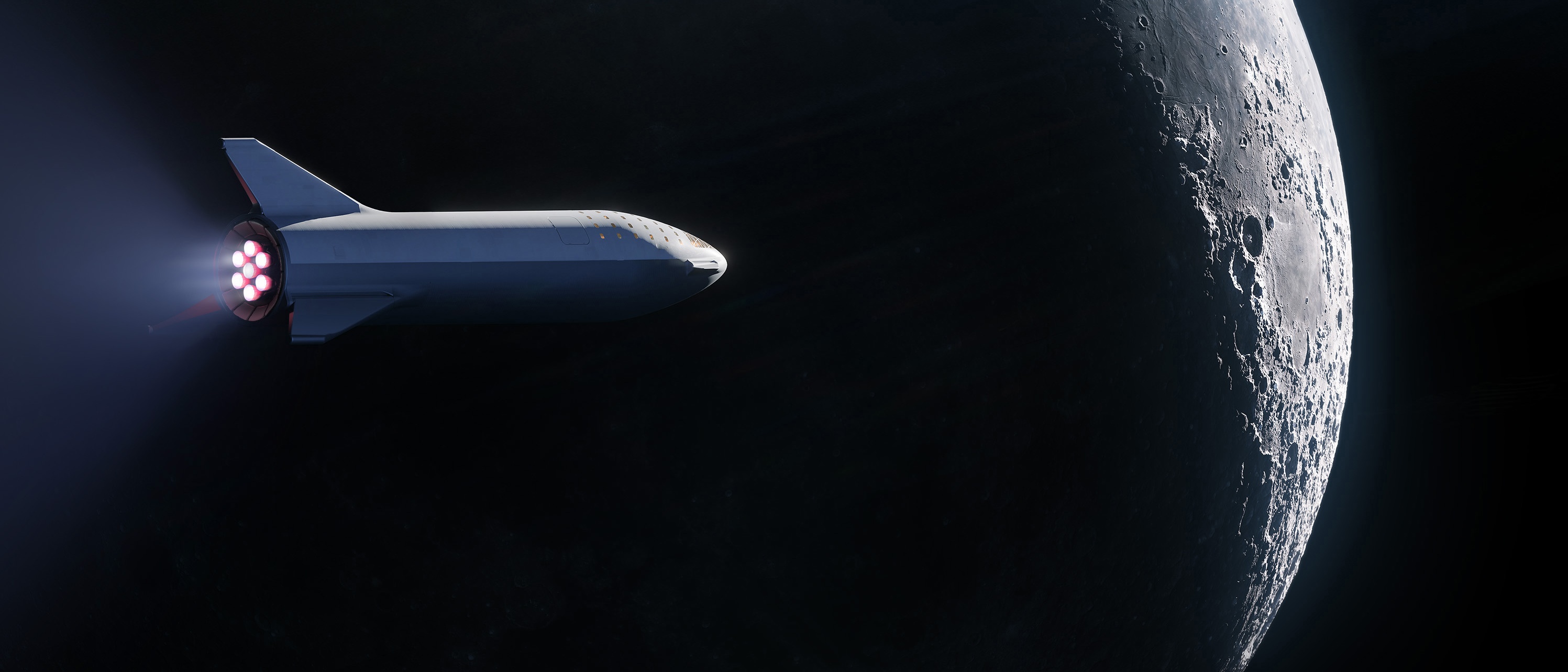 SpaceX Starship design as of September 2018 at the unveiling of the #dearMoon mission, with seven identically-sized engines in the engine layout
 The launch of SpaceX's SN8 Starship prototype, as viewed from South Padre Island, TX.
 Elon & Starship SN9
 Elon & the Starships (50711597728)
 Elon & The Starship (50710186528)
 Starship SN9 sitting on the launch pad with the build site in the background ahead of its test flight.
 FPS trešnja Airmiha
 SpaceX's Starship fully stacked.
 Test version of the SpaceX Starship, undergoing preparations for launch on the afternoon of April 16, 2023, at Boca Chica, Texas
 SpaceX Booster4/Starship 20 stack about to undergo practice fueling, April 16, 2023
- Starship - book chapter published in 2022
- A new launch pad failure mode: Analysis of fine particles from the launch of the first Starship orbital test flight - 2024 paper by Dotson et al., Q1860
- Are space scientists ready for Starship—the biggest rocket ever? - scientific article published on 11 August 2022
- Despite test flight failure, Starship poised to transform space science - scientific article published on 20 April 2023
- Starship, SpaceX’s transformational megarocket, makes it to space - scientific article published on 18 November 2023
| Type | Subtype | Date | Description | Notes | Source |
|---|---|---|---|---|---|
| commons | image | SpaceX Starship design as of September 2018 at the unveiling of the #dearMoon mission, with seven identically-sized engines in the engine layout | Commons | ||
| commons | image | The launch of SpaceX's SN8 Starship prototype, as viewed from South Padre Island, TX. | Commons | ||
| commons | image | Elon & Starship SN9 | Commons | ||
| commons | image | Elon & the Starships (50711597728) | Commons | ||
| commons | image | Elon & The Starship (50710186528) | Commons | ||
| commons | image | Starship SN9 sitting on the launch pad with the build site in the background ahead of its test flight. | Commons | ||
| commons | image | FPS trešnja Airmiha | Commons | ||
| commons | image | SpaceX's Starship fully stacked. | Commons | ||
| commons | image | Test version of the SpaceX Starship, undergoing preparations for launch on the afternoon of April 16, 2023, at Boca Chica, Texas | Commons | ||
| commons | image | SpaceX Booster4/Starship 20 stack about to undergo practice fueling, April 16, 2023 | Commons | ||


.jpg)
.jpg)


