Q214996: Difference between revisions
From Spacefaring
Q214996
Bot: Automated import of articles |
Bot: Automated import of articles *** existing text overwritten *** |
||
| Line 1: | Line 1: | ||
{{Page|Project Gemini|Classes|NASA's second human spaceflight program}} | {{Page|Project Gemini|Classes|NASA's second human spaceflight program|}} | ||
Latest revision as of 15:56, 17 February 2025
Project Gemini was the second United States human spaceflight program to fly. It was conducted after the first American crewed space program, Project Mercury, while the Apollo program was still in early development. Gemini was conceived in 1961 and concluded in 1966. The Gemini spacecraft carried a two-astronaut crew. Ten Gemini crews and 16 individual astronauts flew low Earth orbit (LEO) missions during 1965 and 1966.
1961 — 1966
Wikimedia, Wikidata
National Aeronautics and Space Administration,
NASA, Ashkenaz, Calvinist Republic of Ghent, Chinland, Democratic Republic of the Congo, Havilah, Kingdom of Martabam-hongsawatoi, Kingdom of Wolaita, Persia, Sikh Confederacy, Tarshish, Dong Fang Hong 2, Ekran, 1961, Republic of Haiti,
-
Location: KML, Cluster Map, Maps,
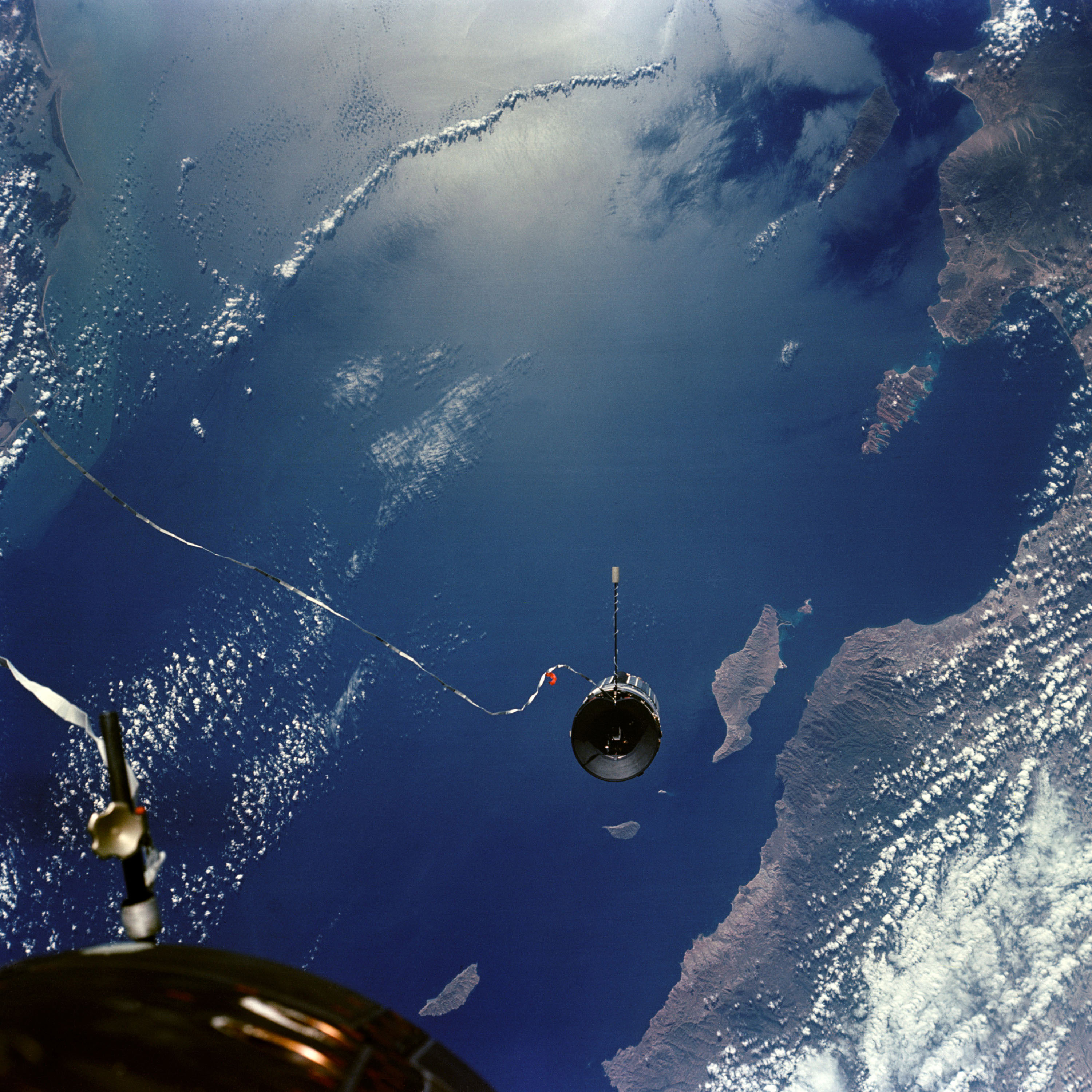 The Agena Target Docking Vehicle is tied to the Gemini 11 spacecraft during its thirty-first revolution over the Earth.
 A Gemini drop test vehicle on display at the Virginia Air and Space Center.
 Spacesuit in Draper Hack the Moon exhibit, 2019
 Gemini program spacesuit in Draper Hack the Moon exhibit, 2019
 Air Zoo December 2019 101 (Gemini crew trainer)
- NASA Project Gemini Familiarization Manual - manual and training aid for Gemini astronauts, English, 1966
- When We Left Earth: The NASA Missions - documentary miniseries, English, 2008
- Space - 1982 novel by James A. Michener, English
- Gemini Monument - monument in the US Space Walk of Fame, USA
- Gemini Monument - monument in the US Space Walk of Fame, USA
| Type | Subtype | Date | Description | Notes | Source |
|---|---|---|---|---|---|
| commons | image | The Agena Target Docking Vehicle is tied to the Gemini 11 spacecraft during its thirty-first revolution over the Earth. | Commons | ||
| commons | image | A Gemini drop test vehicle on display at the Virginia Air and Space Center. | Commons | ||
| commons | image | Spacesuit in Draper Hack the Moon exhibit, 2019 | Commons | ||
| commons | image | Gemini program spacesuit in Draper Hack the Moon exhibit, 2019 | Commons | ||
| commons | image | Air Zoo December 2019 101 (Gemini crew trainer) | Commons | ||


.jpg)