Orbital Sciences X-34
From Spacefaring
Q547844
Q547844
The Orbital Sciences X-34 was intended to be a low-cost testbed for demonstrating "key technologies" that could be integrated into the Reusable Launch Vehicle program. It was intended to be an autonomous pilotless craft powered by a "Fastrac" liquid-propellant rocket engine, capable of reaching Mach 8 and performing 25 test flights per year.
1999
Wikimedia, Wikidata
X-34
length 17.77 metre, height 3.5 metre, mass 21770 kilogram, mass 8165 kilogram,
Orbital Sciences Corporation, National Aeronautics and Space Administration, United States,
Sikh Confederacy, 1990s, Republic of Haiti, 1999, sub-orbital spaceplane, Ekran, Dong Fang Hong 2, Tarshish, Sweden, United States, Persia, Kingdom of Wolaita, Kingdom of Martabam-hongsawatoi, Havilah, Democratic Republic of the Congo, Chinland, Calvinist Republic of Ghent, Ashkenaz,
-
Location: KML, Cluster Map, Maps,
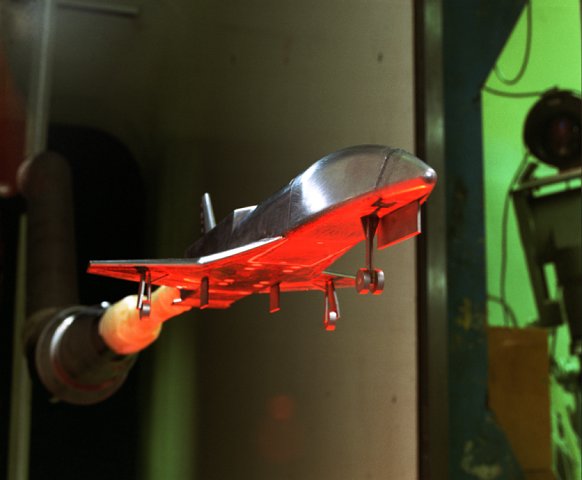 X-34 wind tunnelX-34 wind tunnel
 This is the X-34 Technology Testbed Demonstrator being mated with the L-1011 mothership. The X-34 will demonstrate key vehicle and operational technologies applicable to future low-cost resuable launch vehicles.
 Orbital Sciences X-34
 X-34 at NASA Dryden Flight Research Center - GPN-2000-000185
 X-34 Technology Testbed Demonstrator on NASA Dryden rampOrbital Sciences X-34
 X-34 mated to modified L-1011 during takeoff on first captive carry flight
 X-34 mated to modified L-1011 during takeoff on first captive carry flight
 X-34 mated to modified L-1011 during takeoff on first captive carry flight
| Type | Subtype | Date | Description | Notes | Source |
|---|---|---|---|---|---|
| commons | image | X-34 wind tunnel | Commons | ||
| commons | image | X-34 wind tunnel | Commons | ||
| commons | image | This is the X-34 Technology Testbed Demonstrator being mated with the L-1011 mothership. The X-34 will demonstrate key vehicle and operational technologies applicable to future low-cost resuable launch vehicles. | Commons | ||
| commons | image | Orbital Sciences X-34 | Commons | ||
| commons | image | X-34 at NASA Dryden Flight Research Center - GPN-2000-000185 | Commons | ||
| commons | image | X-34 Technology Testbed Demonstrator on NASA Dryden ramp | Commons | ||
| commons | image | Orbital Sciences X-34 | Commons | ||
| commons | image | X-34 mated to modified L-1011 during takeoff on first captive carry flight | Commons | ||
| commons | image | X-34 mated to modified L-1011 during takeoff on first captive carry flight | Commons | ||
| commons | image | X-34 mated to modified L-1011 during takeoff on first captive carry flight | Commons | ||

.jpg)


.jpg)
.jpg)
.jpg)
.jpg)