Ranger 7
From Spacefaring
Ranger 7 was the first NASA space probe to successfully transmit close-up images of the lunar surface back to Earth. It was also the first completely successful flight of the Ranger program. Launched on July 28, 1964, Ranger 7 was designed to achieve a lunar-impact trajectory and to transmit high-resolution photographs of the lunar surface during the final minutes of flight up to impact.

1964-07-28T00:00:00Z
1964-07-28T00:00:00Z
1964 Ranger 7
1964-07-28T00:00:00Z
1964-07-28T00:00:00Z
rocket launch
{"selectable":false,"showCurrentTime":false,"width":"100%","zoomMin":100000000000}
 Altitude: 3.6 miles. Area: 1.8 miles on a side. Smallest Visible Crater: 30 feet in diameter; 1 feet deep. Features: Angular rock mass in crater at upper left. Preliminary study indicates the mass to be several separate chunks.
 Head-on view of Ranger's six television cameras. The picturesreceived from Ranger are more than twice as good as those received on ordinary home television sets.
 Altitude: 11 miles. Area: 5.5 miles on a side. Smallest Visible Crater: About 45 feet in diameter. Features: Crater near upper left of area outlined in white.
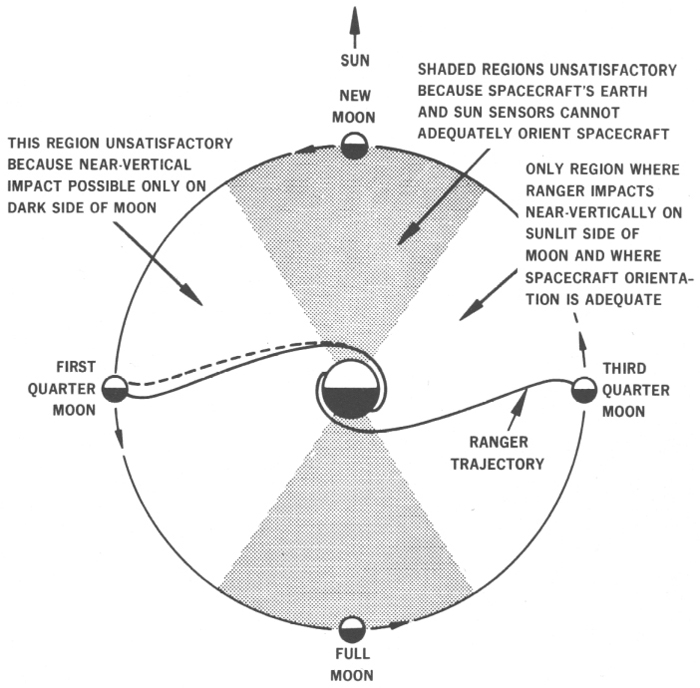 Diagram illustrates why moon's third quarter is only acceptable time for launching Ranger.
 Typical Ranger Launch to Moon
 Photograph of moon (above) outlines aiming point area in Sea of Clouds were Ranger VII landed at 6:25:49 a.m. EDT, July 31. Map (below photograph) shows targeted and actual impact points, which are about 8 miles apart.
 Ranger 7
 Mid-course Maneuver
 Photo taken by Ranger VIl at 3000-foot altitude shows area 100 feet in each side. Note rounded shoulders of secondary craters (see text).
 Last picture by Ranger VII, taken about 1600 feet above the moon, reveals features as small as 15 inches across. Receiver noise pattern at right results from spacecraft crash on the moon while transmitting.


