Ranger 6
From Spacefaring
Ranger 6 was a lunar probe in the NASA Ranger program, a series of robotic spacecraft of the early and mid-1960s to obtain close-up images of the Moon's surface. It was launched on January 30, 1964 and was designed to transmit high-resolution photographs of the lunar terrain during the final minutes of flight until impacting the surface. The spacecraft carried six television vidicon cameras—two wide-angle and four narrow-angle —to accomplish these objectives. The cameras were arranged in two separate chains, or channels, each self-contained with separate power supplies, timers, and transmitters so as to afford the greatest reliability and probability of obtaining high-quality television pictures. No other experiments were carried on the spacecraft. Due to a failure of the camera system, no images were returned.

 Ranger 6
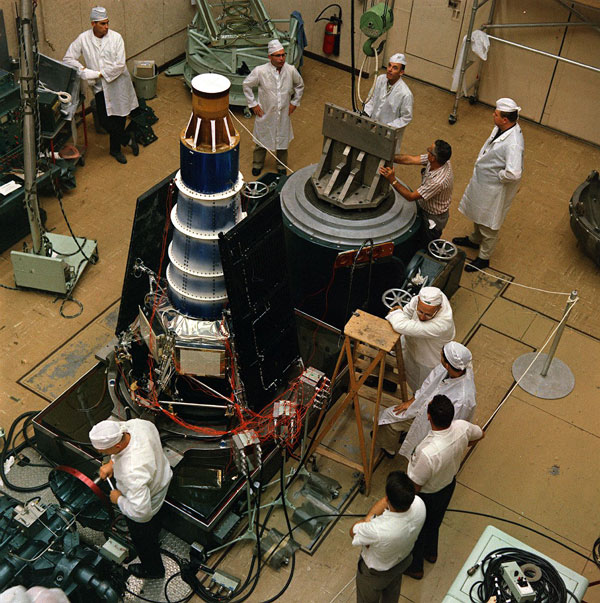 Jet Propulsion Laboratory : Granite Oil Slip Table ranger 6 (1963)
 1964 71390L
| Type | Subtype | Date | Description | Notes | Source |
|---|---|---|---|---|---|
| incident | incident | [[1]] | Wikidata | ||
| commons | image | Ranger 6 | Commons | ||
| commons | image | Jet Propulsion Laboratory : Granite Oil Slip Table ranger 6 (1963) | Commons | ||
| commons | image | 1964 71390L | Commons | ||


