ASTERIA
From Spacefaring
Q46259364
Q46259364
ASTERIA was a miniaturized space telescope technology demonstration and opportunistic science mission to conduct astrophysical measurements using a CubeSat. It was designed in collaboration between the Massachusetts Institute of Technology (MIT) and NASA's Jet Propulsion Laboratory. ASTERIA was the first JPL-built CubeSat to have been successfully operated in space. Originally envisioned as a project for training early career scientists and engineers, ASTERIA's technical goal was to achieve arcsecond-level line-of-sight pointing error and highly stable focal plane temperature control. These technologies are important for precision photometry, i.e., the measurement of stellar brightness over time. Precision photometry, in turn, provides a way to study stellar activity, transiting exoplanets, and other astrophysical phenomena.

 PIA22413 – Astrophysics CubeSat Demonstrates Big Potential in a Small Package, Figure 4
 PIA22413 – Astrophysics CubeSat Demonstrates Big Potential in a Small Package, Figure 2
 PIA22413 – Astrophysics CubeSat Demonstrates Big Potential in a Small Package, Figure 1
 ASTERIA CubeSAt lens alignment
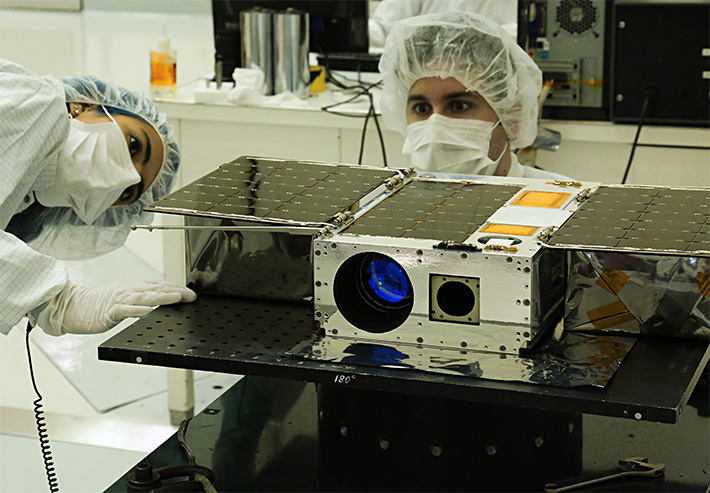 ASTERIA CubeSat space telescope
| Type | Subtype | Date | Description | Notes | Source |
|---|---|---|---|---|---|
| commons | image | PIA22413 – Astrophysics CubeSat Demonstrates Big Potential in a Small Package, Figure 4 | Commons | ||
| commons | image | PIA22413 – Astrophysics CubeSat Demonstrates Big Potential in a Small Package, Figure 2 | Commons | ||
| commons | image | PIA22413 – Astrophysics CubeSat Demonstrates Big Potential in a Small Package, Figure 1 | Commons | ||
| commons | image | ASTERIA CubeSAt lens alignment | Commons | ||
| commons | image | ASTERIA CubeSat space telescope | Commons | ||


